Showing posts with label Garden; small creatures; wildlife. Show all posts

Sunday, 26 August 2012

Grasshopper ?

Following on from the bug theme, we photographed this specimen enjoying our China Asters.

Speckled Bush-cricket Leptophyes puntatissima. (Corrected from the Short-winged Conehead: Thanks Susan)


Normally found in gardens, It is the first one we have noticed.

We like the Kukri knife shaped ovipositor!! Its a good job its not ten times larger...

Saturday, 28 January 2012

A Triumph of Hope over Experience...

Or just how misguided can you get?

This little ladybird was spotted (no pun intended) crawling on the buds of a hyacinth out in the garden today.


It obviously hasn't seen the weather forecast, or it would have known that within minutes of posing for this photograph it would be hailing and sleeting in equal measure. Not fit weather for a ladybird to be out and about!

Either that, or it's got some mighty fine thermals and a good set of wellies!!

Wednesday, 23 November 2011

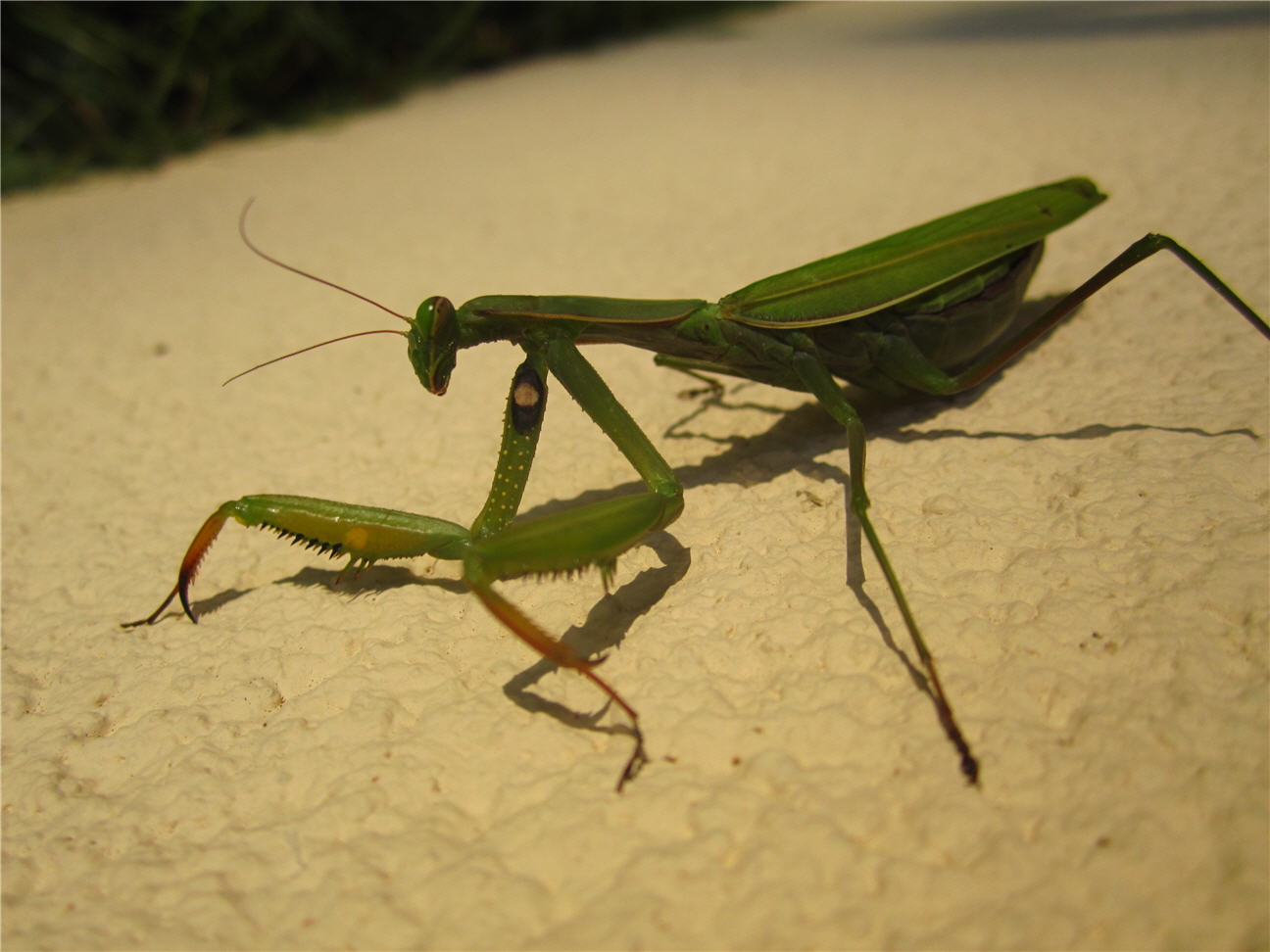
Return of the Mantis

One of the earliest postings we wrote was about finding a praying mantis in the garden. We had managed to photograph it back in October last year when we were busy felling the leylandii which had previously hidden the house from the outside world.

During the intervening months we haven't seen any more of these fascinating creatures.... until a couple of weeks ago I spotted one sunning itself on the side of the house.


It is such an amazing sight that we felt it worth a posting. This one was about 10cm long from head to tail but it's front legs are out of all proportion to the rest of its body and so make it seem much larger.

Its name comes from its 'prayer-like' stance, which is adopts when advancing on its prey.


 Mantises are predatory. The two forelegs are spiked to catch and hold secure their prey. They protect themselves by camouflage and concealment.


On the photo below you will see yellow 'eye spots' on the forelegs. These are shown in threat displays to startle the enemy.


Since the sighting two or three weeks ago we haven't come upon it again... Perhaps it will be another year before we see this magnificent creature again!

Wednesday, 28 September 2011

Bug Magnet

Our Asters have taken over from the lavender as the bug magnet of the moment.

Although generally honey bees making one almighty buzz, when you look closely there is a variety of the different species enjoying the nectar.. Here are a selection.


Just a note about the Asters, when we moved in there was one small clump in the front of the house. Elizabeth dug the clump up split it and planted bits here and there.... We are now overrun with them.... The insects appreciate them though!

Monday, 5 September 2011

Biting off more than it could chew..

We watched a couple of tiny lizards in the garden yesterday. Eventually one of them spotted a spider: a spider about as big as the lizards head.


The chase was on.... and the spider fell victim to the lizard.


A quick flick of the head and licking of the lips and the job was done - or so we thought...


When the lizard turned we realised it had spat out most of the spiders body ...


This little creature had bitten off more than he could chew. When a second spider ran across his path he couldn't even be bothered to give it a second chance.

Could it be that you can have too much of a good thing??

Saturday, 13 August 2011

Gomphocerippus rufus alias Rufous Grasshopper!!

Well at least that is what I think it is!! I am certain one of our readers will put me right...

I prefer 'Big Brown Grasshopper' its more descriptive. It was hopping and flying around our Haricots last night when Elizabeth was harvesting them. (She carries the camera everywhere!!)

When it moved it wings appeared to give a blue sheen and it looked quite attractive..  Although we didn't hear it, the song resembles a sewing machine working in 5 sec bursts. (that's if it is Rufous)


Pity there wasn't a few of them. I bet they are quite tasty tossed with a bit of butter in a hot pan!!

Elizabeth also spotted a Grass Snake last night.... Can you???


Tuesday, 5 July 2011

Macroglossum stellatarum continued

Today the Humming Bird Hawk Moth was back. My objective was to attempt to photograph it with its wings frozen in time.. (Wing speed 85 beats per second) With my camera set on its fastest shutter speed ( 1/8000 sec) these were some of the results...


I think it really does look like a bird

Monday, 4 July 2011

Macroglossum stellatarum

Macroglossum stellatarum or to you and me The Humming Bird Hawk Moth. I photographed this one happily feeding on our lavender bushes at the front of the house. The lavender bushes were a mass of insect life this afternoon but this moth was a joy to watch and photograph as it hovered from flower to flower.


It is a species of Sphingidae. Its long proboscis and its hovering behaviour, accompanied by an audible humming noise, make it look remarkably like a hummingbird while feeding on flowers.


Adults are particularly fond of flowers with lots of nectar. They are reported to trap-line, i.e. return to the same flower beds at about the same time each day. I will see if that is true tomorrow.....

Thursday, 30 June 2011

Heres looking at you....

Caught this little beauty posing readily this morning.


I think it is a juvenile  female Meadow Grasshopper (Chorthippus parallelus) but am probably completely wrong.
It is clearly flightless....

But does make a good picture...


I tried in vain to ask it what is was trying to do on my teasel (Dipsacus Fullonem) but the reply sounded like a sewing machine... anyway it was certainly "Full on em"!!!

Tuesday, 10 May 2011

Bees on the poplars

We've spoken before of bees on the walnut tree and today it was the turn of the poplars.


Fifty six poplars mark the boundary of three sides of the garden and today they are humming with the sound of bees.


Upon investigation we learned that they are collecting a resinous mixture called Propolis. You can see the resin on the surface of the leaves. First thing this morning it wasn't particularly sticky but and as it warms up in  the sun it becomes more so.


Poplar resin, or propolis, is rich in flavonoids and its biological role is to seal wounds and defend against bacteria, fungi and insects.

As for the bees, propolis is believed to
  1. reinforce the structural stability of the hive
  2. reduce vibration
  3. make the hive more defensible by sealing alternate entrances
  4. prevent diseases and parasites from entering the hive, and to inhibit bacterial growth
  5. prevent putrefaction within the hive. Bees usually carry waste out of and away from the hive. However if a small lizard or mouse, for example, found its way into the hive and died there, bees may be unable to carry it out through the hive entrance. In that case, they would attempt instead to seal the carcass in propolis, essentially mummifying it and making it odourless and harmless 

In view of all these properties, perhaps we should consider setting up in partnership with the bees and marketing Braye Propolis...after all, it's all in a day's work for your average bee!